Packing Is Going To Be Tricky...
⬅ previous ⬆intro next ➡Day 14 ~ January 27 ~ Buenos Aires
This morning, we have a private half-day guided tour of the city. We're starting in the Recoleta district, next door to the Palermo district where our hotel is.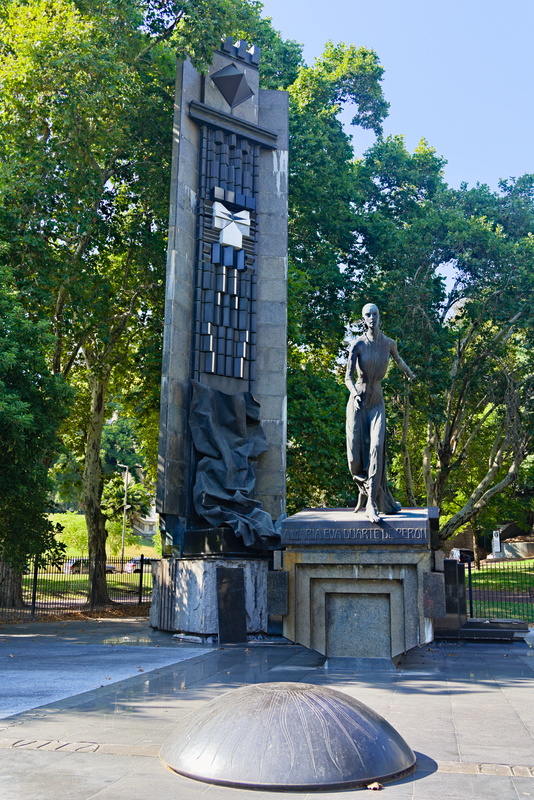
We'll start with the Monumento a María Eva Duarte de Perón. Hmm... Evita... Rice and Lloyd Webber... Madonna... In a very different way, it's another of those things like the Falklands/Malvinas: something we sort of vaguely remember in the UK, but which is absolutely real and alive in Argentina.
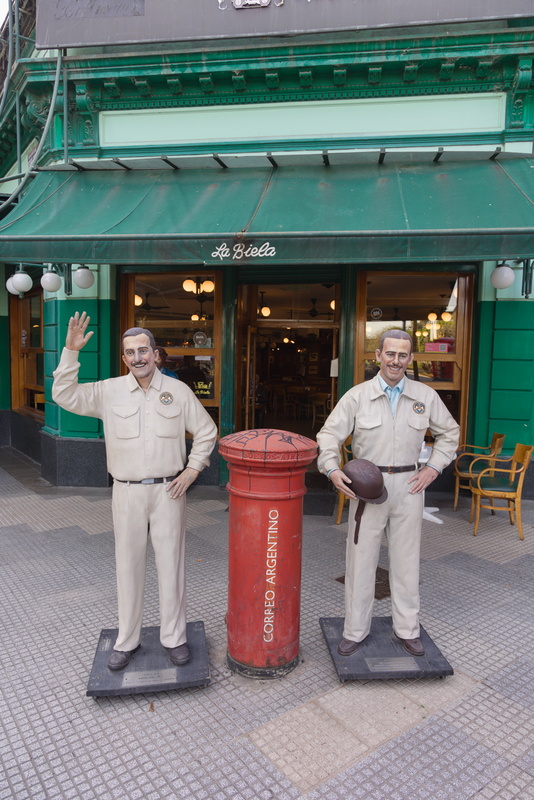
“La Biela” café is a famous landmark. It's named after a car engine part – a “con rod” in English! Why? Well, according to the café's website history page, a group of motor enthusiasts, having exhausted the patience of their neighbours, took themselves off for a drive and one of them broke down on this corner. They all gathered in the bar and privately renamed it after the broken part that had brought them there.
In the 1950s it became associated with top racing stars like Juan Manuel Fangio, but also many other notable writers, artists and others. The website lists many of them, but strangely is silent on who these statues are.
Fortunately, as you can see, they have informational plaques on their bases, and by zooming in I can tell you that the figure on the left with his hand raised is Juan Gálvez, born here in 1916 and killed in a racing accident in 1963; on the right is his brother, Oscar Alfredo, also a racing driver, nicknamed “Aguilucho” – “Little Eagle”. He had modest success in Formula 1, but both of them were many-times champions of the Turismo Carretera, the oldest auto racing series still active in the world according to that page!
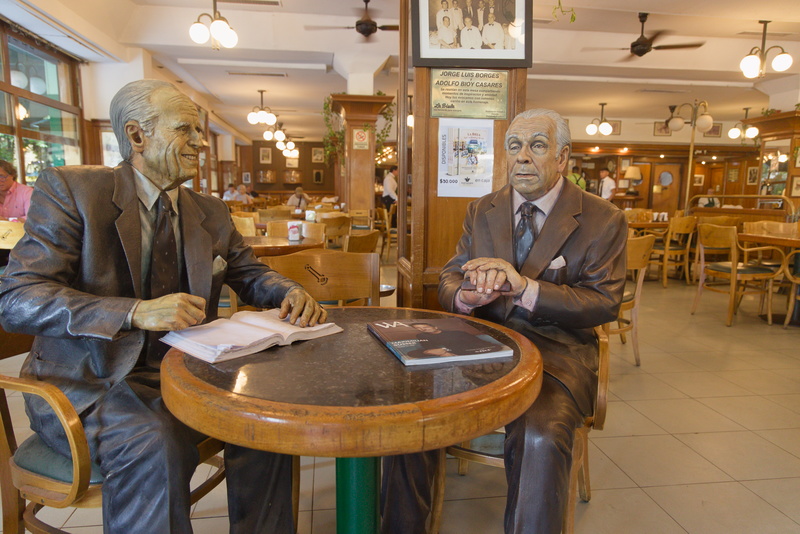
Inside we have Jorge Luis Borges and Adolfo Bioy Casares.
I make the rash assumption that everyone shares my relative knowlege and ignorance here, so I won't talk about Borges, but I don't think I've ever heard of Casares, certainly not that I remember.
Wikipedia tells us that he was a friend of and frequent collaborator with Borges, and his breakthrough novel was La invención de Morel (“The Invention of Morel”, or perhaps better, “Morel's Invention”, because it's something he invents, not himself being invented) with cover art by Borges’ sister Norah. Wikipedia's description of the novel makes it sound distinctly odd: perhaps I need to dig it out.
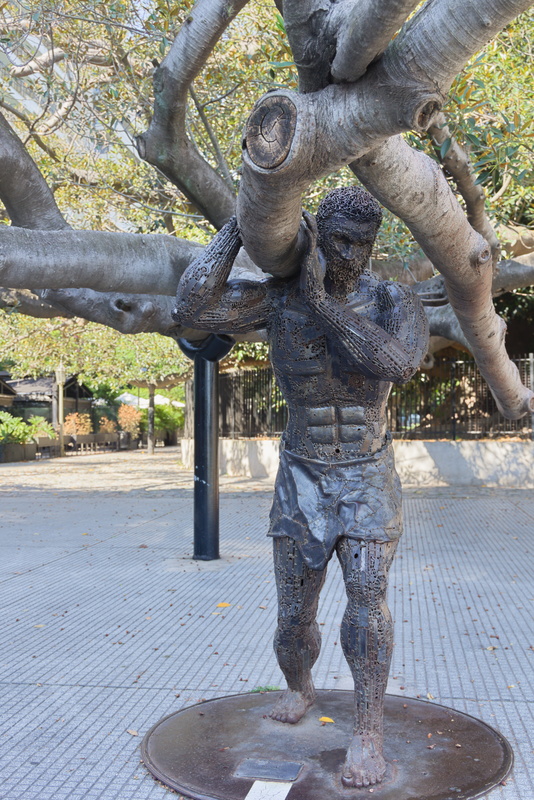
Just across the square from the café.
In the wild, Ficus elastica sends out these branches (which aren't branches but aerial roots) to help it support its heavy weight. In this more urban setting, we have a statue of Atlas made from scrap car parts to carry the load.
It's quite a famous piece: here for example, is one of the many web pages about it. It tells us that, “Atlas de la Recoleta is 1,85 m. tall, weighs around 250 kg [...] over three thousand [...] car parts[...] from the 50s and 60s”. The artist is the Uruguayan scuptor Joaquín Arbiza.
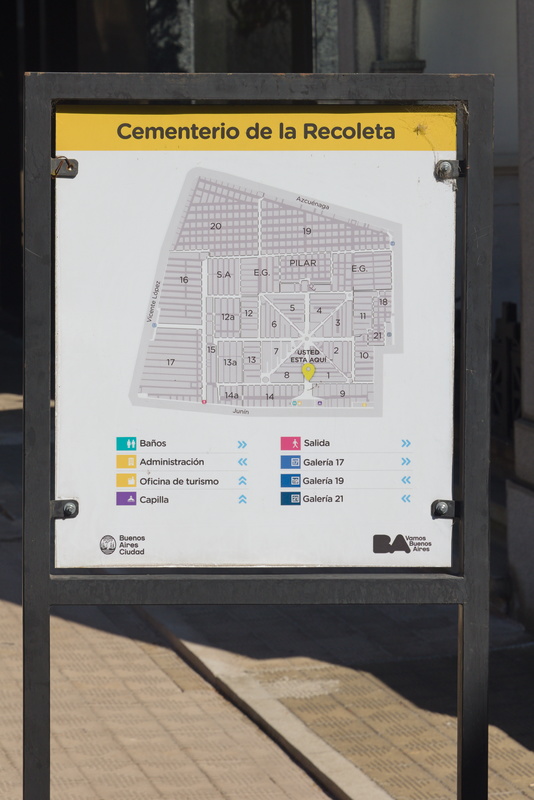
A cemetery as tourist attraction? Not at all unusual, really. People make pilgrimages to Jim Morrison's grave in France and Highgate Cemetery's website says, “We recommend first-time visitors take a guided tour”.
We've not visited either of those two, although Highgate is on the “one of these days” list, ideally in conjunction with the Hidden London Highgate Station tour. Unfortunately, that particular tour hasn't been on the event calendar for some years now. We were actually booked onto it for 2017, but for reasons I can't remember right now, either they or we had to cancel. I'm thinking that it was them: I won't swear to it, but I do have pictures of us at Northala parkrun (with Pat volunteering) so clearly we were able to travel to North London that day.
Anyway, whatever, it's part of our tour: now back to the dead people...
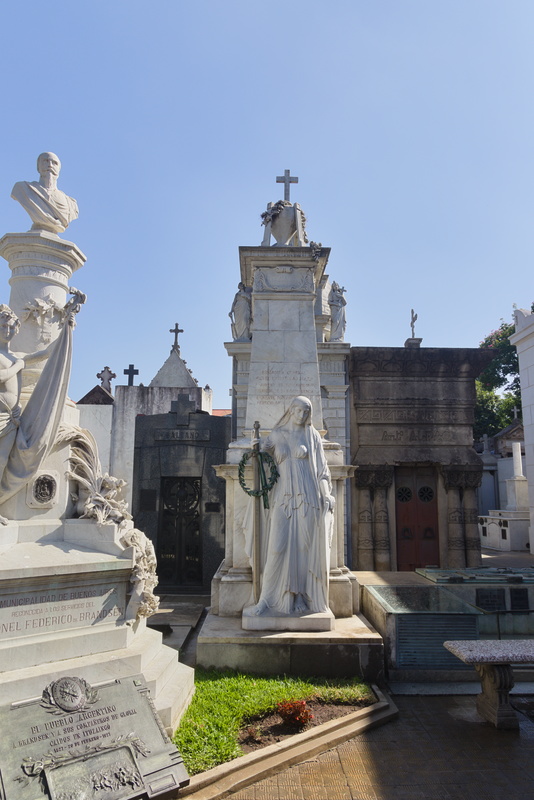
Gosh, it's quite grand, that cannot be denied.
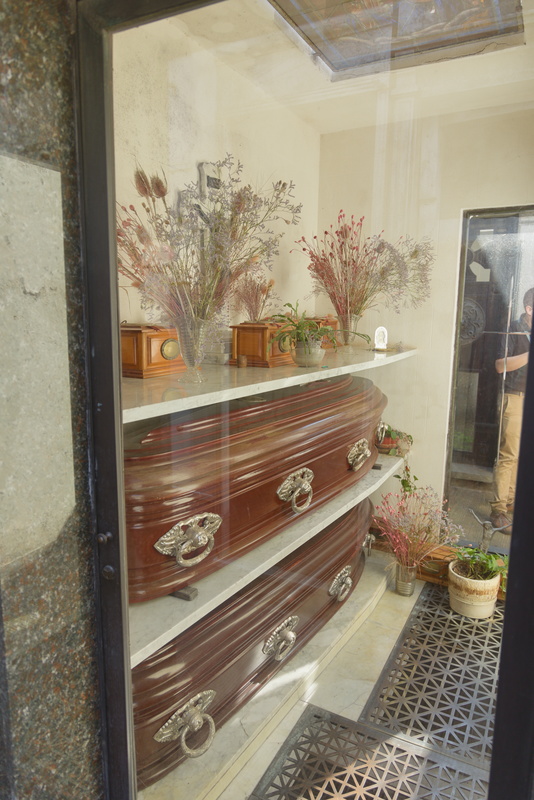
Some of the mauseoleums are more like conservatories, with a display of coffins, cremation urns and flowers on display.
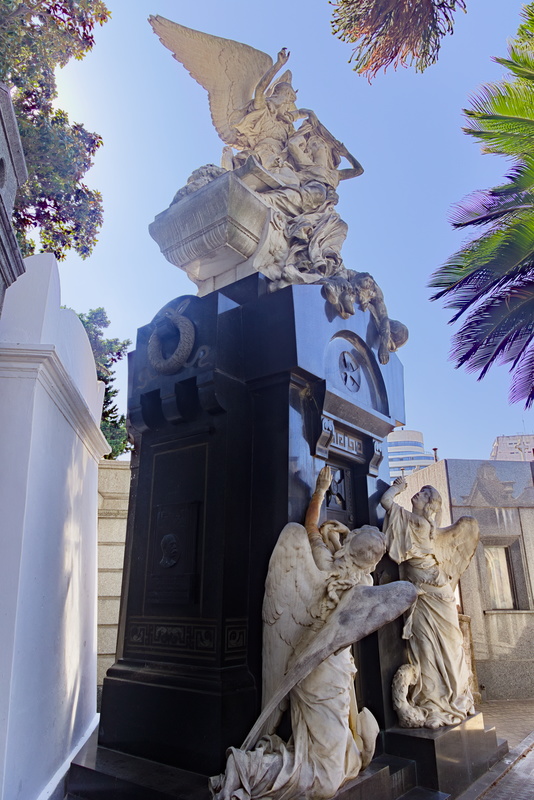
Hmm.... Restrained understatement doesn't really feature here.
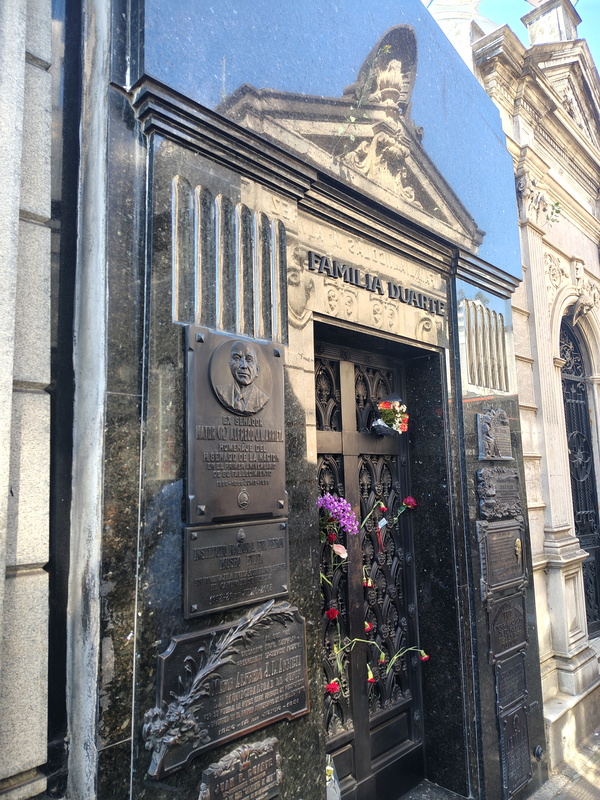
Who might the Duarte family be? If you don't know, there's an obvious lucky guess.
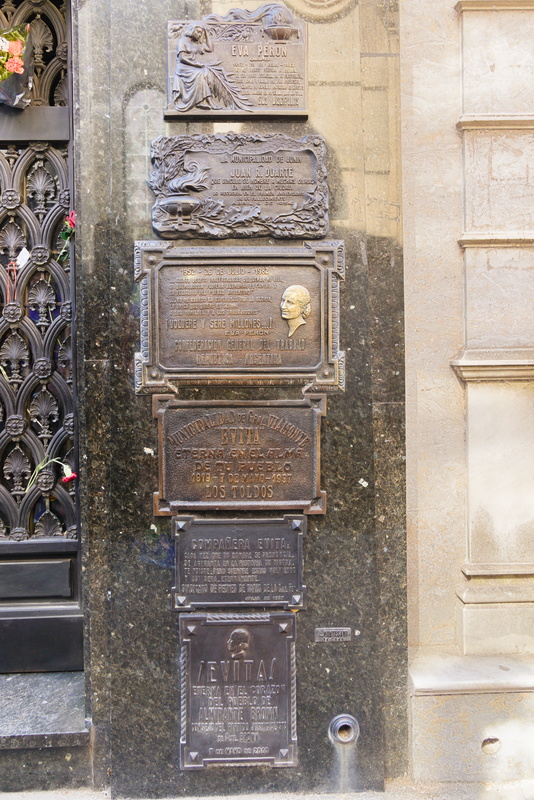
Yeah, of course, Evita.
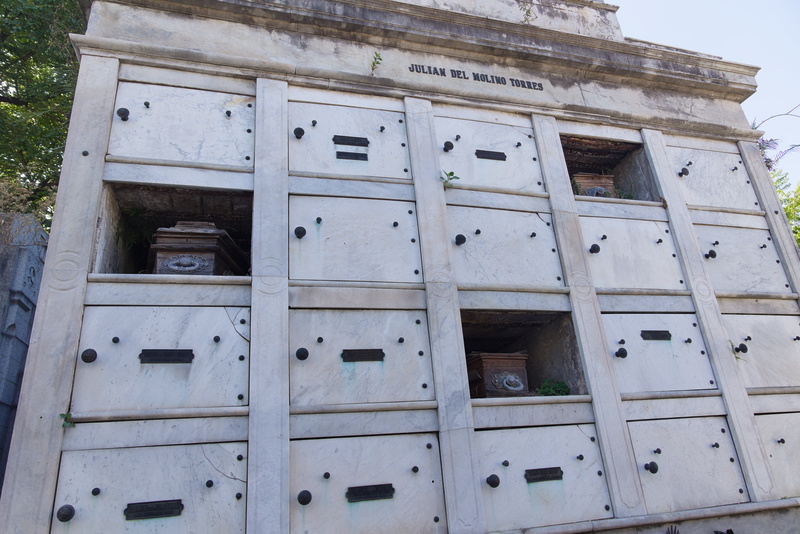
Oh wow, it's a bit like one of those marquetry cabinets full of tiny drawers you see in stately homes, only this is a stone cabinet the size of a house with coffins in the drawers...
So again: it's a cemetery, Jim, but not as we know it!
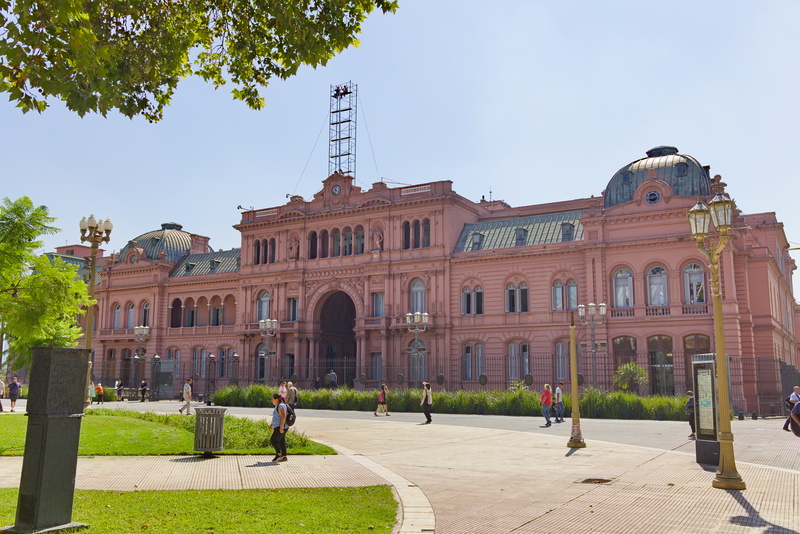
Moving on, what do you think this pink palace might be? If I tell you the Spanish language name is “Casa Rosada”, does that help? Compare “Casa Blanca”? Is that a clue? Yep, it's the Presidential Palace. I would tell you more about it, but when I go to the official website, the front page has as its most important item, “Participation of President Javier Milei in the debate on ‘Keynes and General Theory’ in the Freedom Palace”. I'll be honest: I'm up there for a debate on an obscure topic with the best of ‘em, but even I have my limits.
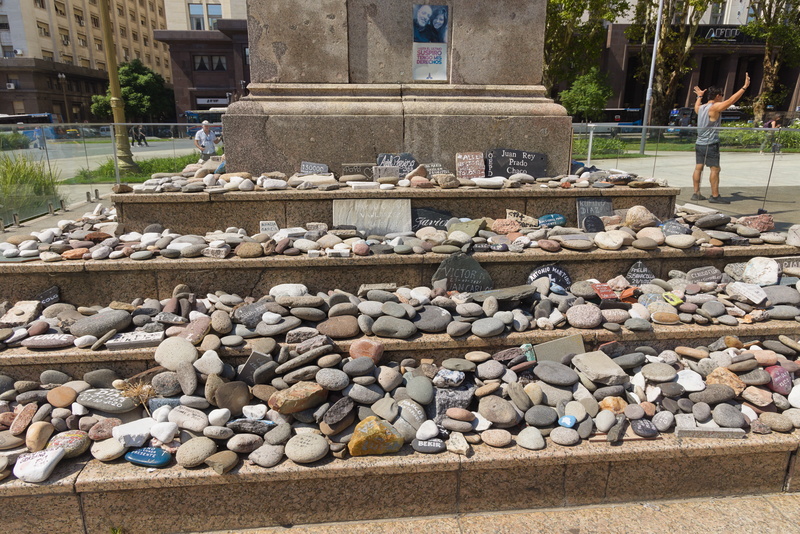
So we'll turn away from the palace, into the Plaza de Mayo, the square in front of it. Each of these stones bears the name of someone who died from COVID in the pandemic, placed by family and friends to protest the government's handling of the crisis in August 2021.
This is definitely the place to protest against the goverment: in the 1970s and 80s, the “Mothers of May Square” (Madres de Plaza de Mayo) began demonstrating here for the the desaparecidos, people who had “disappeared”. The military junta was unimpressed, and also disappeared – murdered – many of their leaders.
It's all a lot more peaceful now, although the Madres still march every Thursday in support of wider social causes.
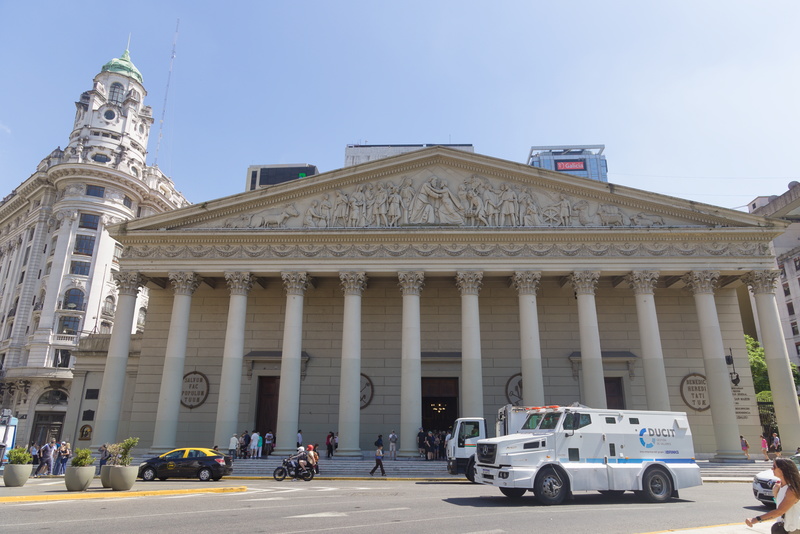
Just off the square, the Metropolitan Cathedral.
There has been a cathedral here since soon after the foundation of the city in 1580, but this building dates back to the 18th century. Despite the Greek temple appearance, it has the cross-shaped plan view of a conventional church and looks much more conventional from the inside. See Wikipedia's article here.
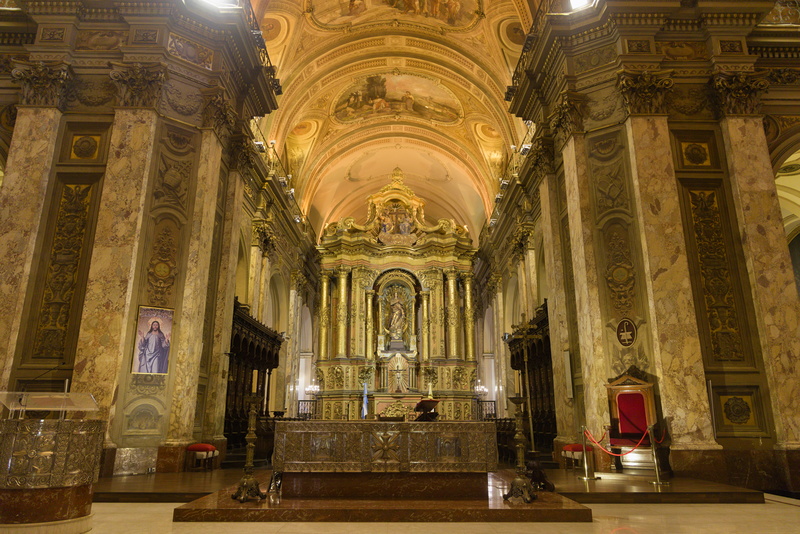
Yep, that's some Catholic bling there, sure enough.
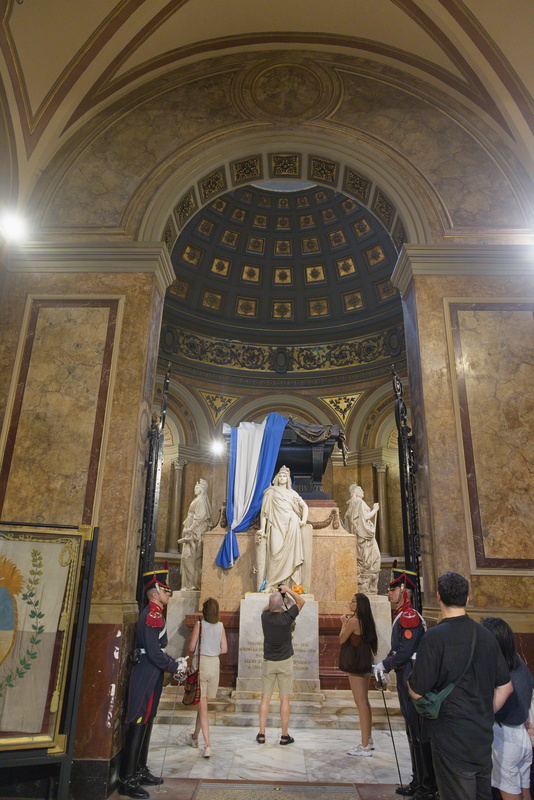
We also have the mausoleum of General José de San Martín, the national hero of Argentina, Chile and Peru. Jeremias hasn't said anything, but there's a reason we are here at this specific time.
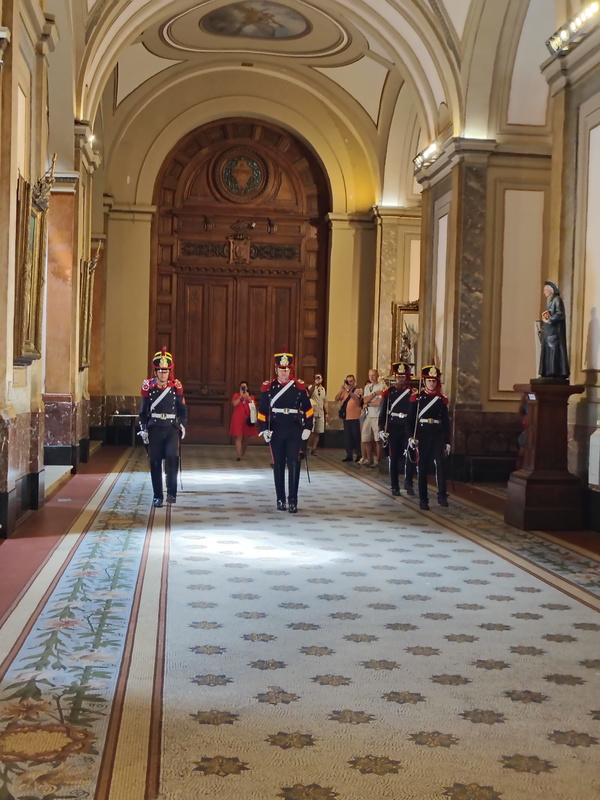
It's the changing of the guard.
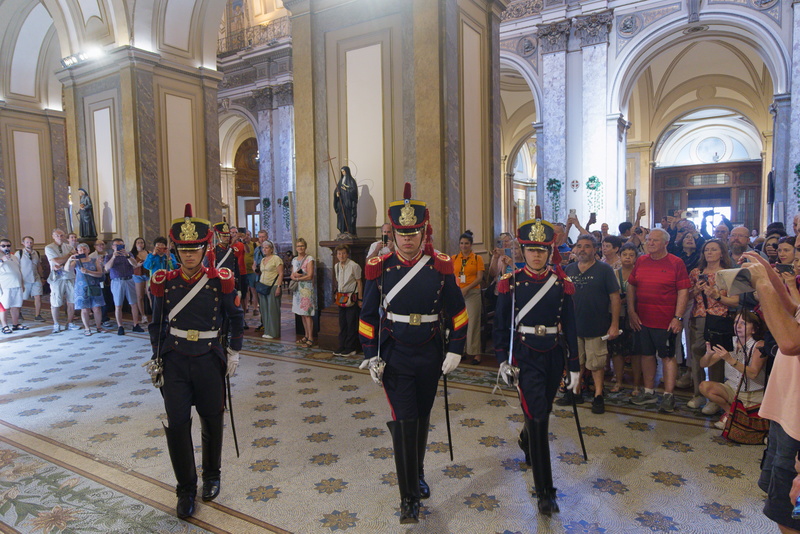
More by luck than judgement, I'm right in the front.
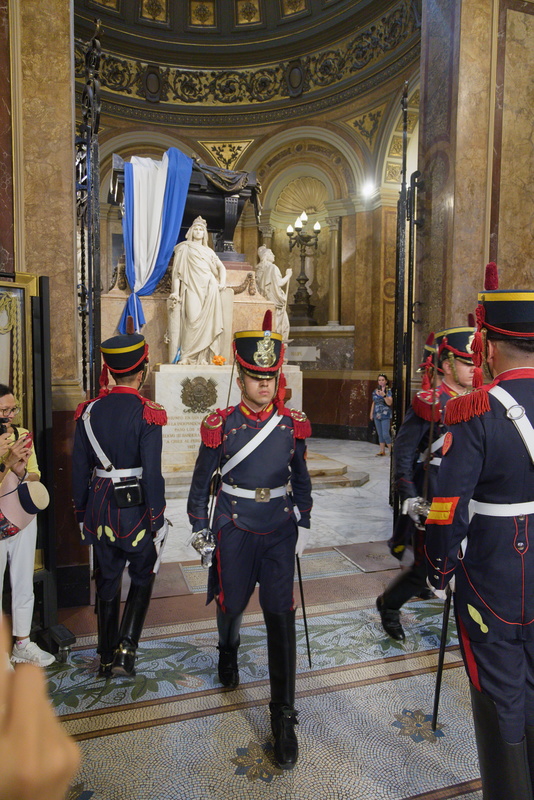
The guards are from the “Regiment of Mounted Grenadiers”, founded by General San Martín himself.
Wikipedia, as always, is a font of knowledge about the regiment, and I am most taken by some of the key points in the Regiment's Code of Honour.
It is unbecoming of an officer “to cheat like a tradesman” (point 5); “to be seen in public with women who are known prostitutes” (point 12); and “to gamble with low and baudy people outside of the officer corps” (point 13, there are 14 in all).
And now, as they say, for something completely different: “El Caminito”.
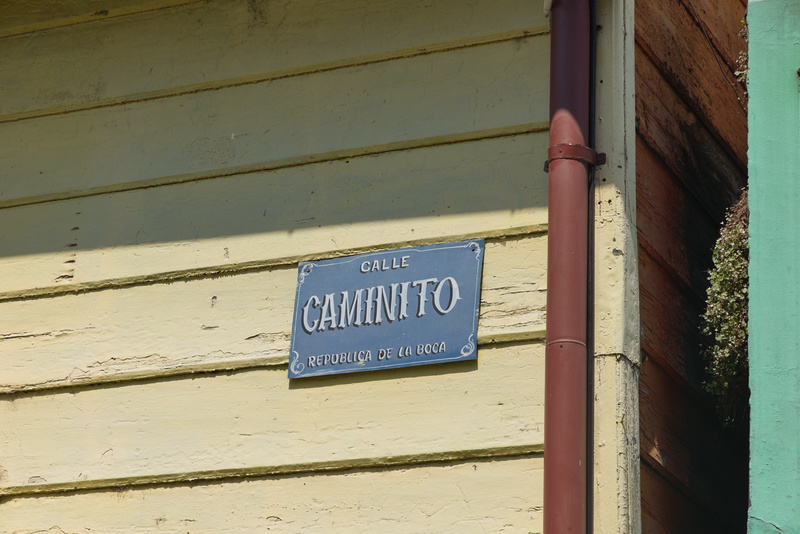
Literally “little path”, the diminutive of camino, although that word itself covers a multitude: the best known instance is probably the “Camino de Santiago” – the Way of St James – which is a network of pilgrimage routes across Europe dating back to mediaevel times. But this too is a bit of a figurative use, because it's now a serious tourist attraction, a sort of open-air museum.
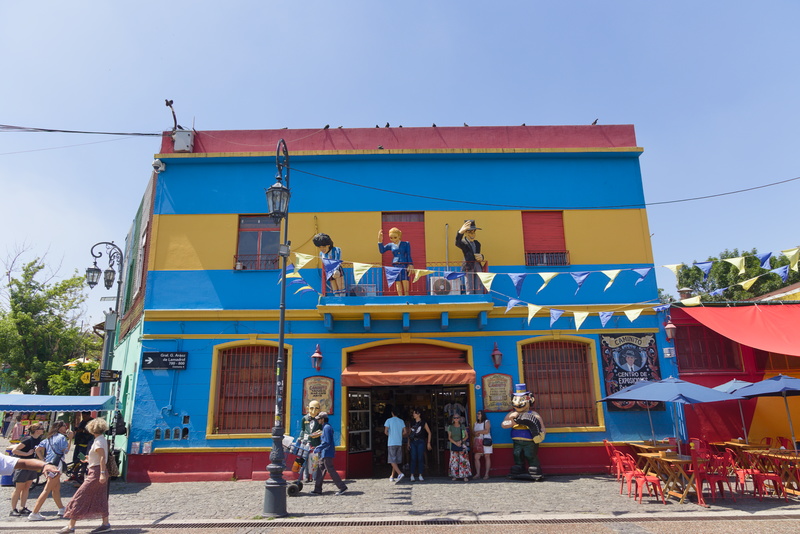
The brilliantly coloured buildings are what everyone comes to see.
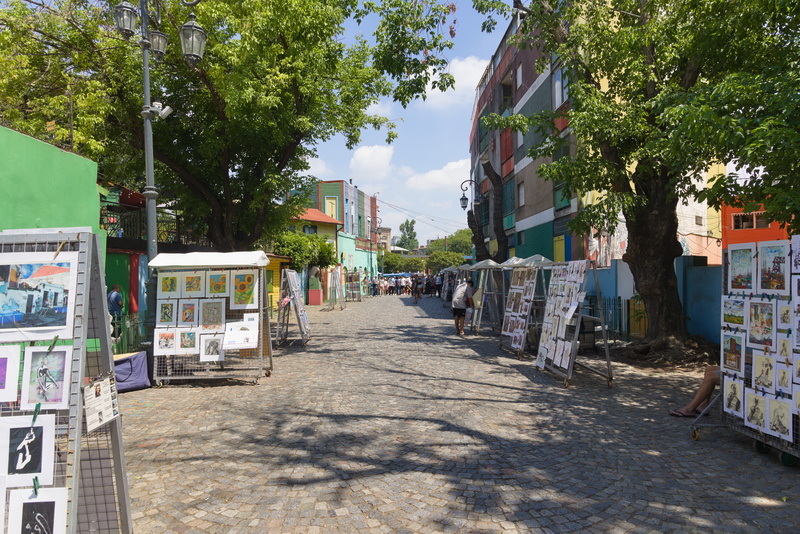
Artists display their wares for sale.
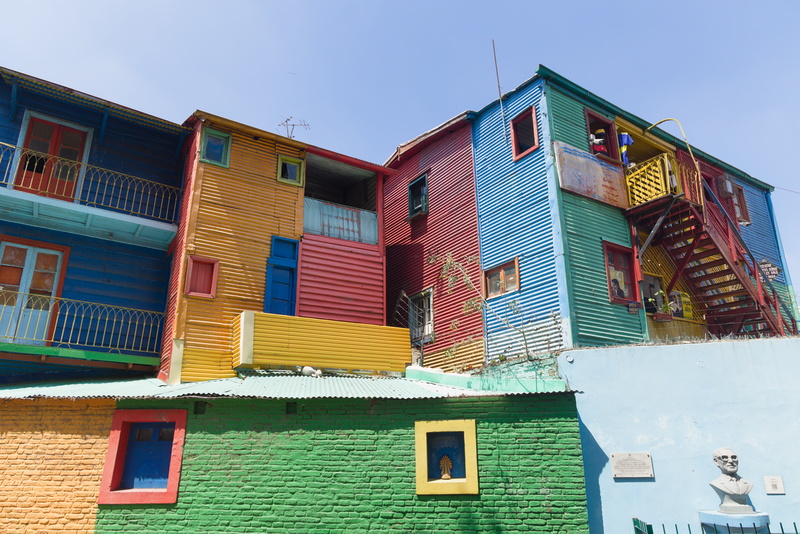
It's really a former slum district that's come up in the world: local artist Benito Quinquela Martín began to decorate the tenements in the mid-20th century, at which time it was all but derelict.
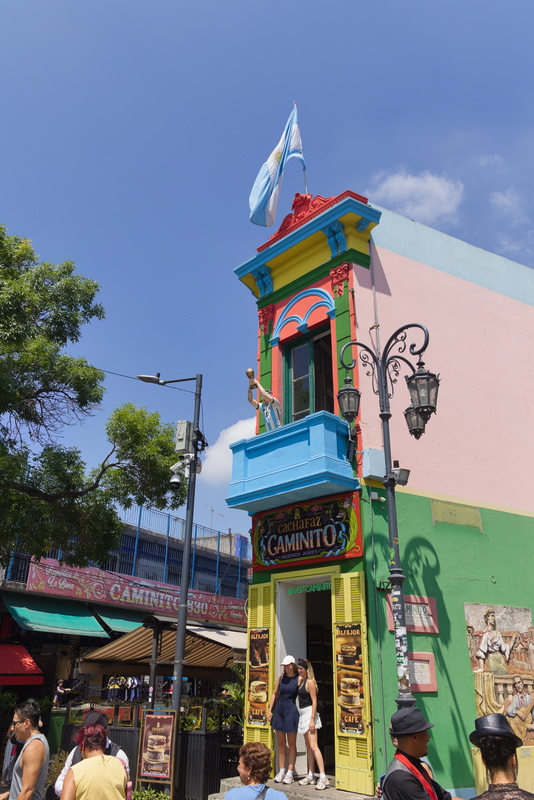
This is a particularly famous chocolate shop, and people queue for their selfies in the doorway. We are not quite so shallow.
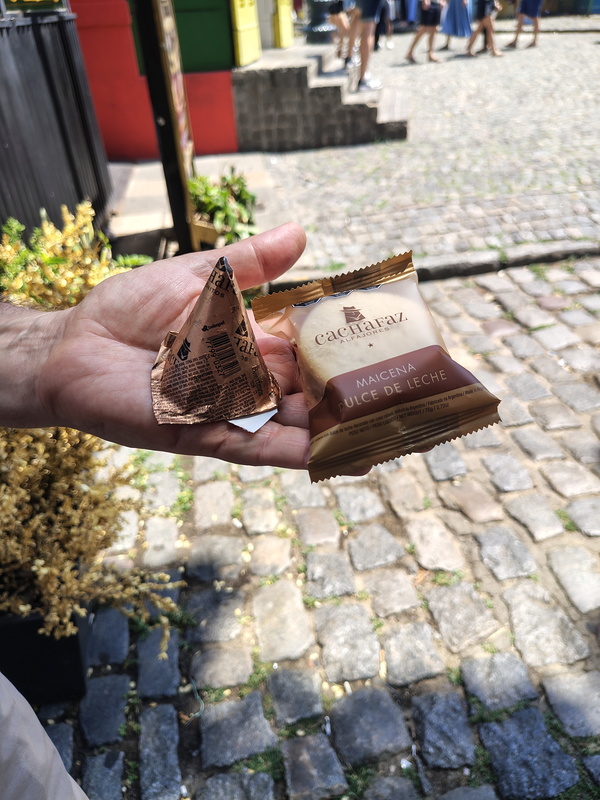
Jeremias gets us a couple of samples to try. In all honesty, they're a bit sweet for our taste, but it's part of the experience and fun of the fair.
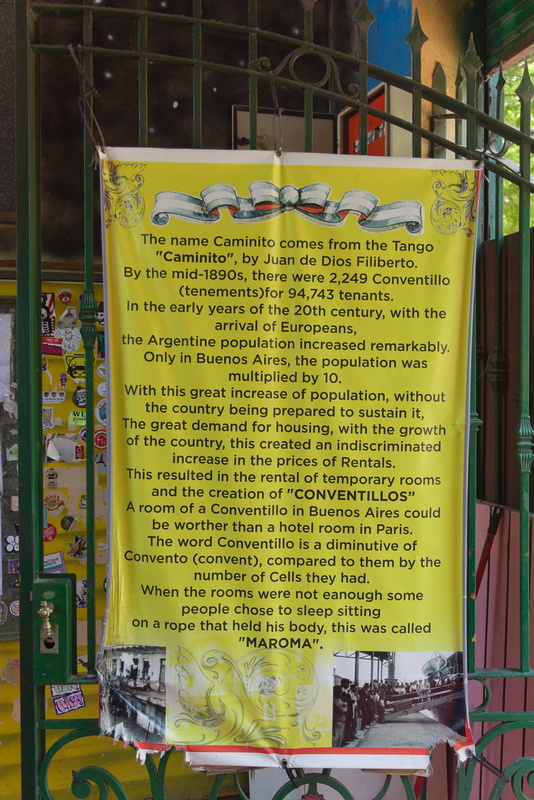
Some more information for you. I have a feeling this English text was probably courtesy of Google Translate or similar, but it's more-or-less comprehensible. Other, perhaps more reliable, sources seem to suggest that the tango was named for the area rather than vice-versa
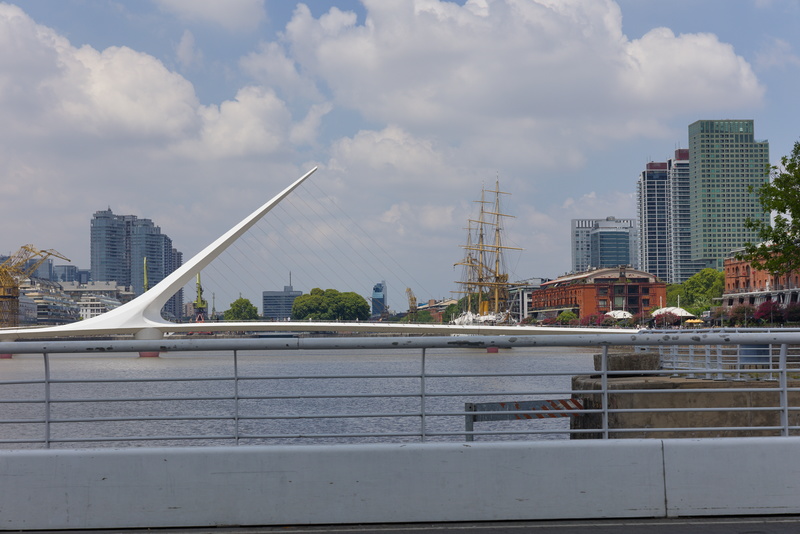
Back in the car, we cross the river on one bridge but look across to a footbridge called El puente de la Mujer – “The bridge of the woman” – which we think we might like to check out later.
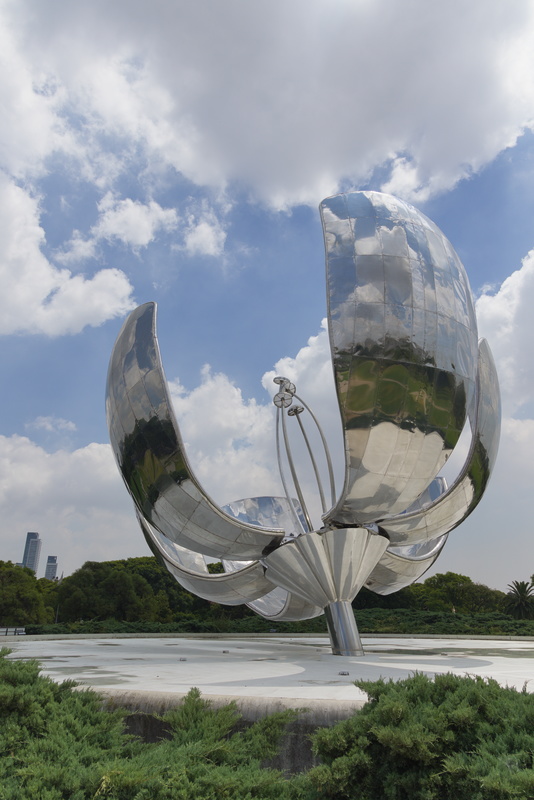
Another square with this stunning stainless steel flower sculpture. It's intended to be in the middle of a reflecting pool, but the pool is dry now. Still impressive though.
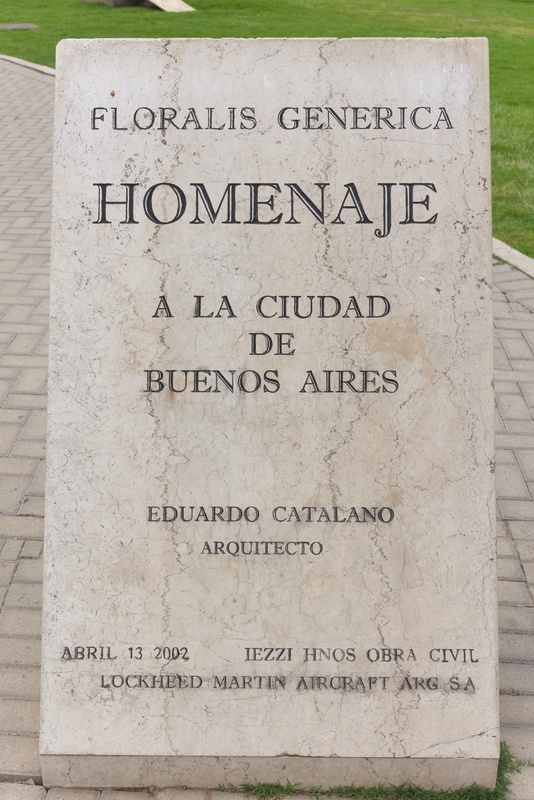
Not a commission, but a gift from the artist to the city.
So that's the end of our tour. We now need a spot of lunch and rather than being taken back to the hotel, we ask to be dropped in the middle of town.
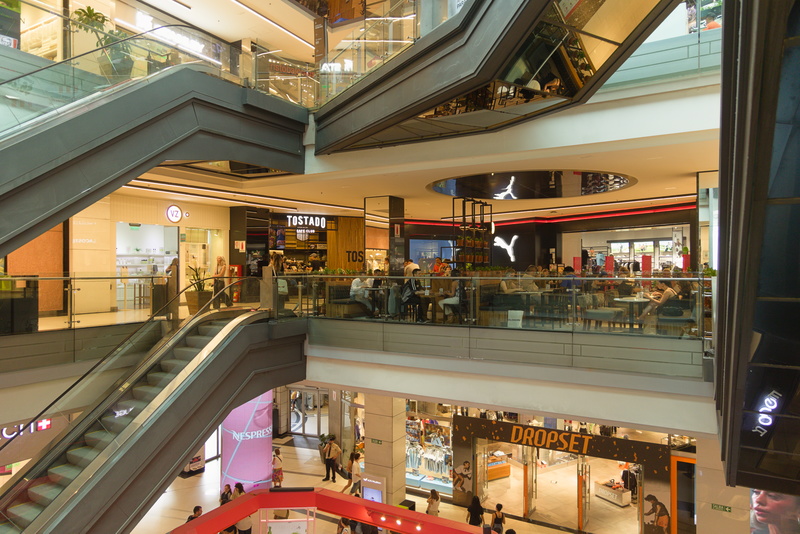
Well we liked Tostado in Ushuaia, let's try this one in the shopping mall.
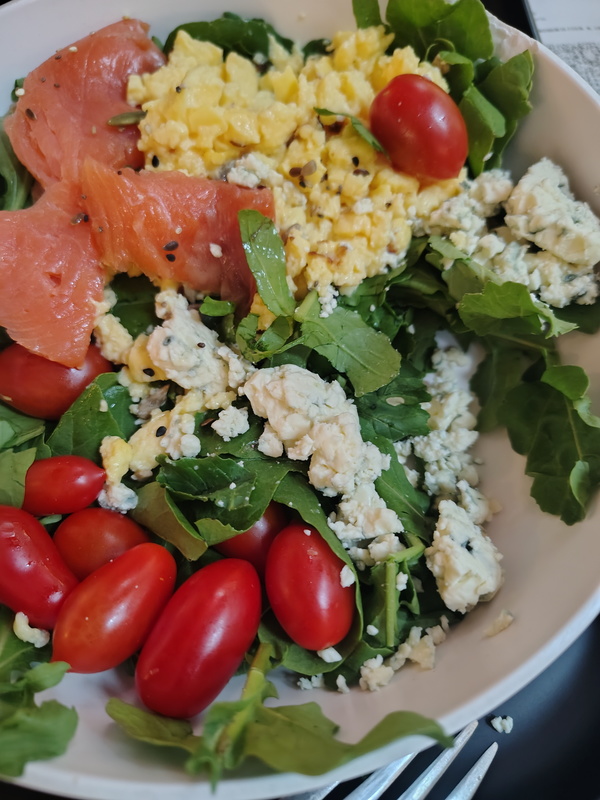
A very decent bit of salad, although no strange man accosts us this time. Amanda doesn't mind.
We must now visit El Ateneo Grand Splendid. More in a moment...
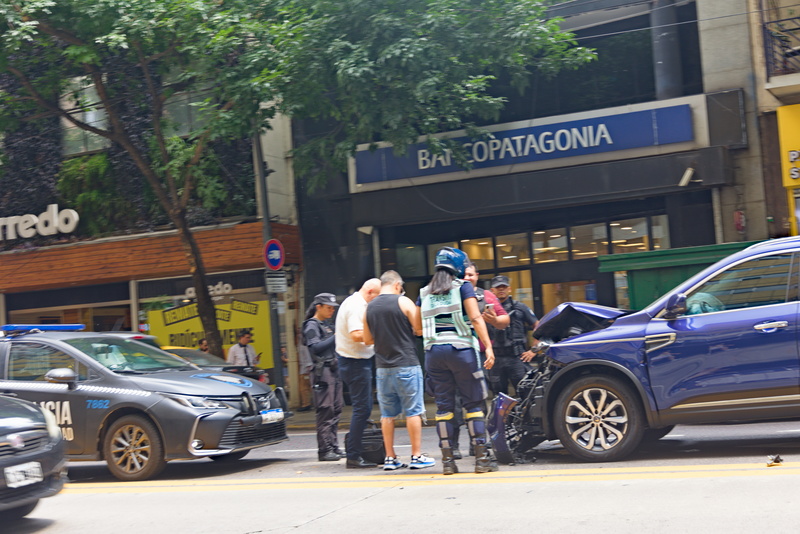
Oops! Not sure what happened here, and it's hard to see how anybody could have been driving fast enough to cause this much damage in the city traffic. Slightly blurry and not quite horizontal because I'm taking this picture from the hip to avoid being too obvious, just in case the police disapprove.
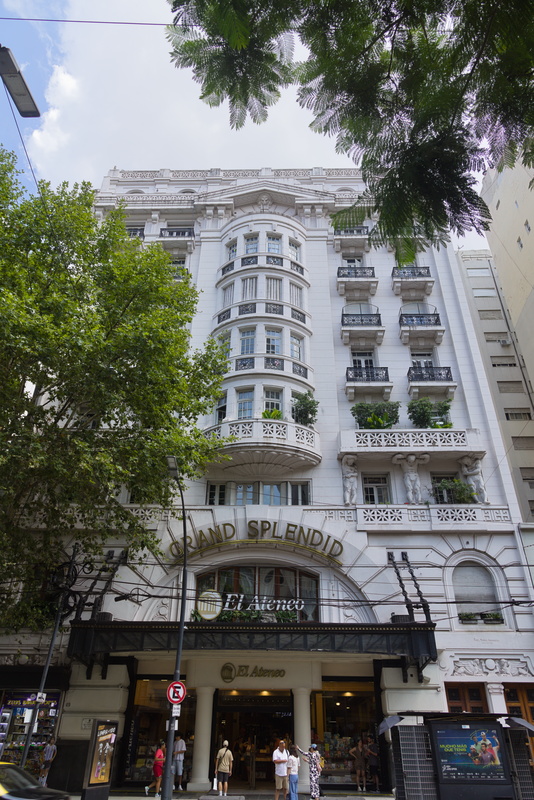
Some say that El Ateneo is the grandest bookshop in the world, some that it's merely second or third, but either way it sounds like something we need to see.
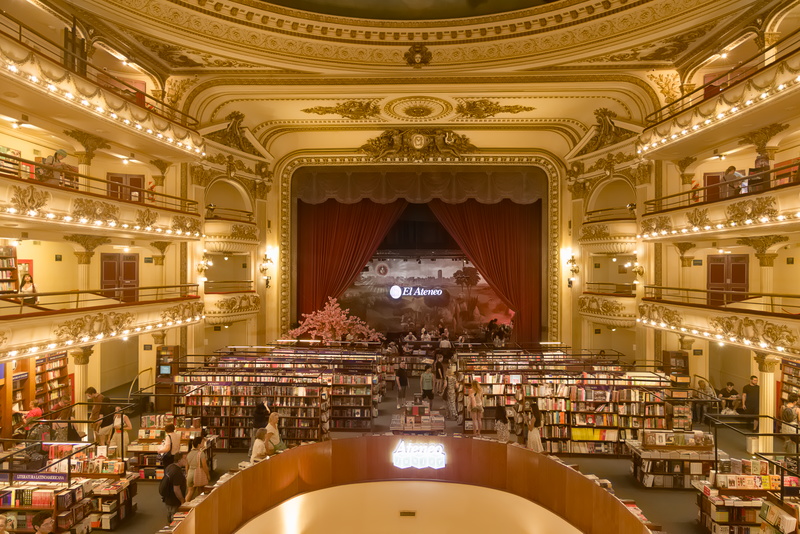
Ok, that's pretty grand!
It was built as a theatre and opened in 1919, but was converted into a cinema a few years later, and in 1929 showed the first films with sound in Argentina. The conversion to a bookshop was done in 2000, and since then The Guardian has declared it the second-best in the world while National Geographic gives it the number one spot!
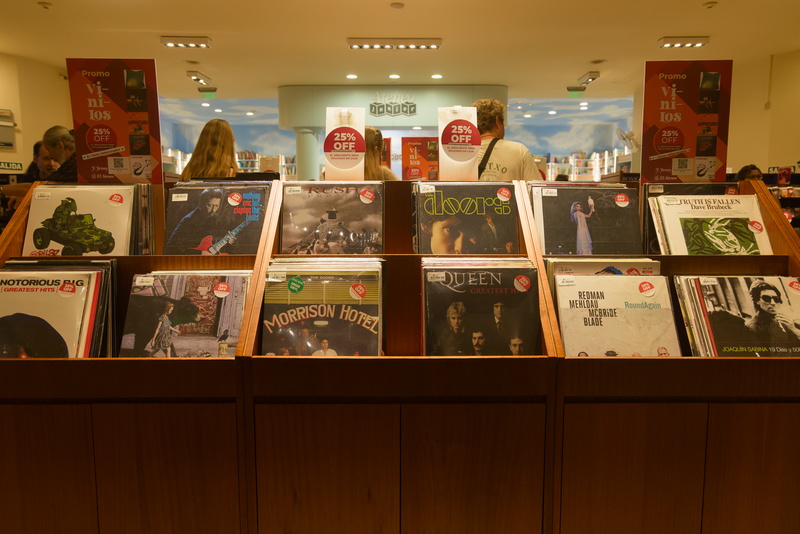
They also sell vinyl albums: a retro vibe that has obviously spread worldwide, though we don't really get it ourselves. A good few years ago, we dug out our old albums and equipment and sold them all and honestly can't say we've regretted it. Quite a few titles we recognise here, and it's pretty hardcore: Rush; Queen from before almost anybody had heard of them (Queen II is brilliant but “We Are The Champions” it ain't!); the Doors...
Not cheap, though: these are mostly tagged as $AR 67,000 which is about £35 and these are the sale items. But then again, that said, Queen II from 1974 would have sold for around £2.50 at the time, and inflation has made that around £30 today in the UK. In fact, I used to buy a lot of records from the second-hand shop near where I lived because I couldn't afford to buy many new on my schoolboy pocket money. I certainly wasn't prepared to risk full price on a random album by a band I didn't know, but Clock House Records in Beckenham could make a good cover painting enough of an excuse.
Oh dear, it's definitely gone downmarket since I lived there. Street View.
We walk back to our hotel, obviously completely oblivious to how my youth has been traduced.
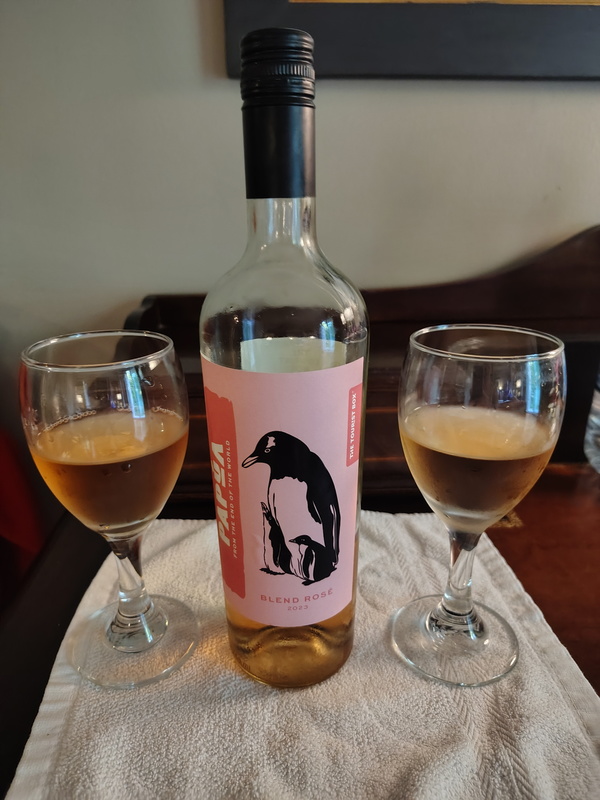
Let's try our penguin wine... Well, it was just meant as a bit of fun... Not undrinkable but we won't buy it again.
For dinner this evening, we are going to a rather special interpretation of an Argentinian staple, the ‘asado’ barbeque, at a place a short walk from the hotel.
This is a gift from Audley. I'm sure we're not their absolute biggest-spending clients, but rather a lot of our disposable income has gone their way over the years and they like to show they appreciate our custom. It may be bribery, but we're all for it. Off we go.
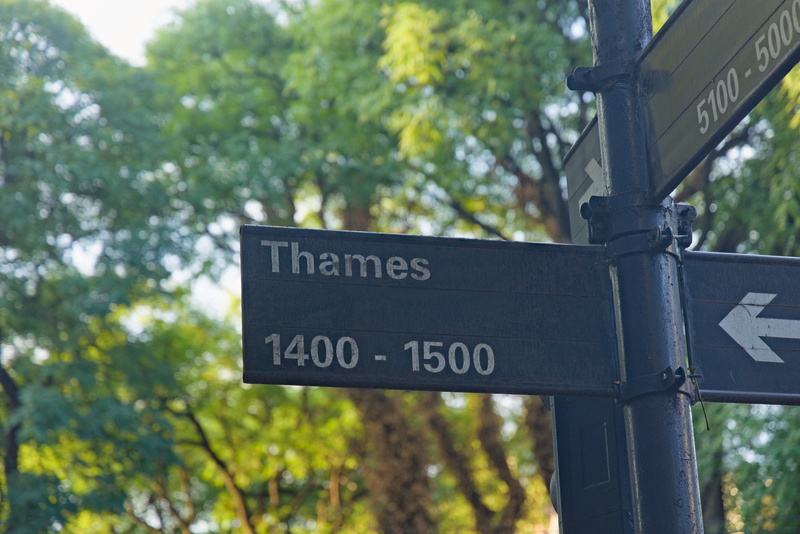
Many, perhaps most, of the roads in the vicinity have some sort of place-related name: “Armenia”, “Honduras”, “Córdoba”, etc, but there's no obvious theme that jumps out. There are no other London or Home Counties references nearby that we can see, but this is Thames Street.
That said, Fogón Asado, our venue, is on the street called “Uriarte” and Wikipedia tells me that “Uriarte is a Basque language surname. Notable people with the surname include:” and then the Argentinian options are Jon Uriarte, María de Uriarte, Nicolás Uriarte and Pedro Francisco de Uriarte. I leave it to the reader to learn/guess which if any of these notables have given their name to the street.
Fogón itself seems just a nondescript door – similar to our hotel in that respect – and when we knock we are told we are slightly early and would we mind waiting outside. Over the next few minutes others arrive and then somebody comes out to check us in.
“May I see your reservation email?”
Ah, no, we don't have one... “What name?” ... “We don't seem to have that” ...
Then Amanda thinks to say that she's booked in as pescatarian, which is definitely a bit of a distinguishing feature here, and all is well! We were booked under the name of the local agent, and somebody obviously didn't realise we needed to be told that.
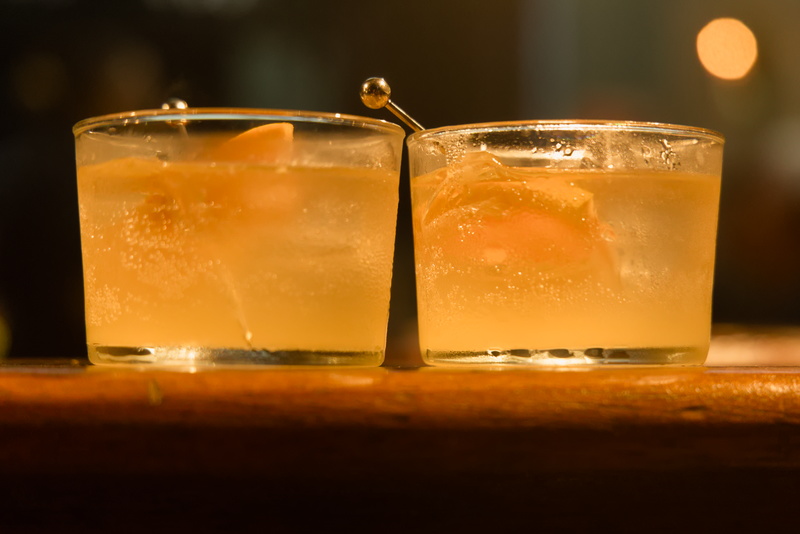
Right, let's start with some welcome drinks while we wait for the last people to arrive and the ceremonies to commence.
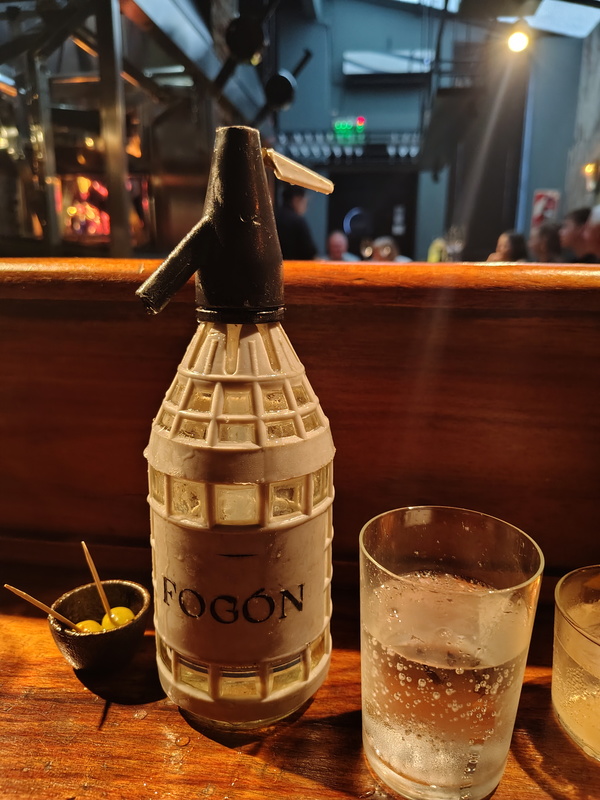
Or if you want some water, they have these interesting bottles that look like old-fashioned soda siphons. However, they're filled with ordinary sparkling water so to get enough pressure to make them work you need to give them a good shake.
(Actually, “old-fashioned soda siphons” are so much a thing of my childhood rather than adulthood that when I started writing this, I realised I'd completely forgotten if they were actually pressurised enough to not need shaking. Some web searching suggests that they were indeed so. You wouldn't refill them yourself, you'd basically return your empty and swap it for a full one at a shop/pub/off-licence. Faint bells are starting to ring... Not to be confused with the type you can still get that uses a separate CO2 cartridge.)
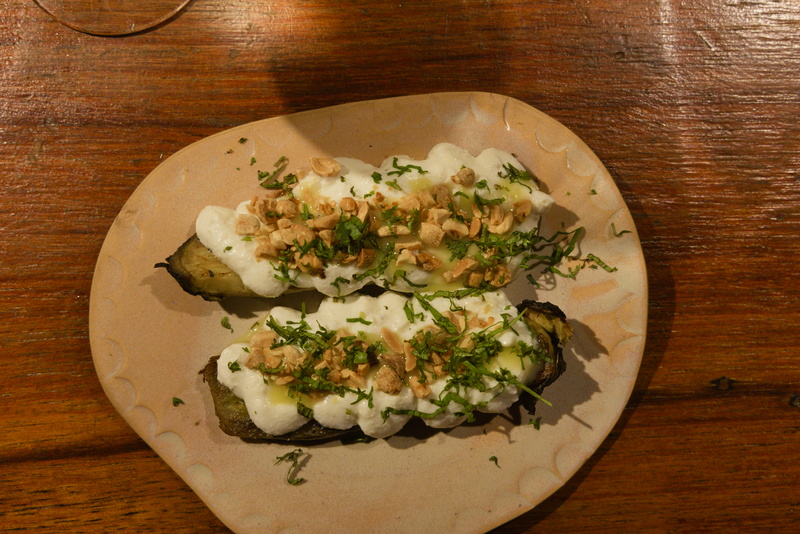
Gosh, it's a vegetarian starter. Pretty looking and yummy tasting, though, so it's a good sign to start.
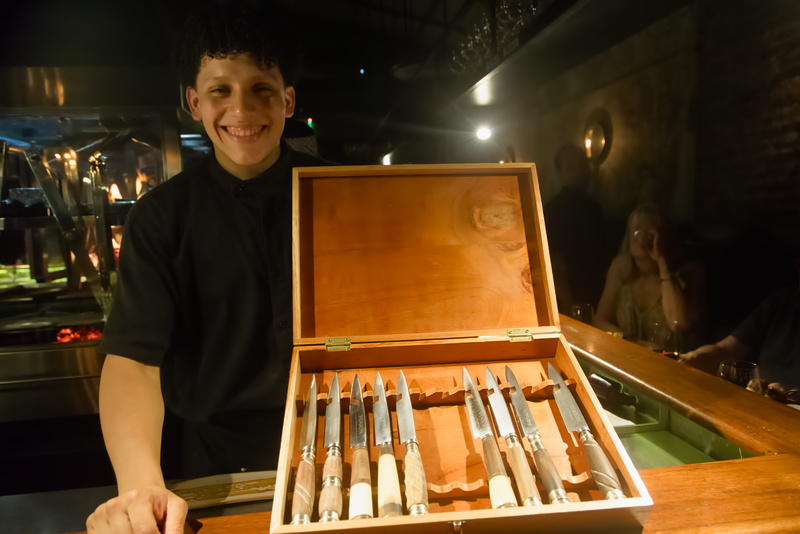
Now here's a first: a knife menu!
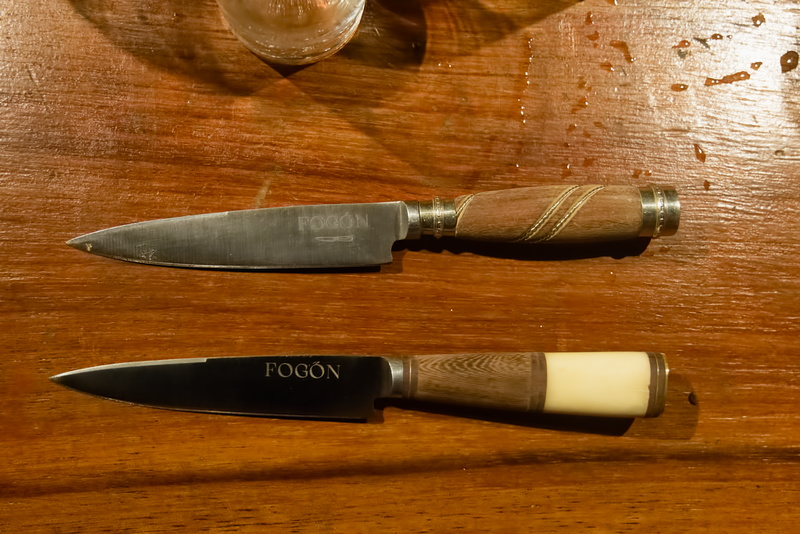
I'm not sure how exactly one should go about choosing the perfect knife, but we've decided we like these two.
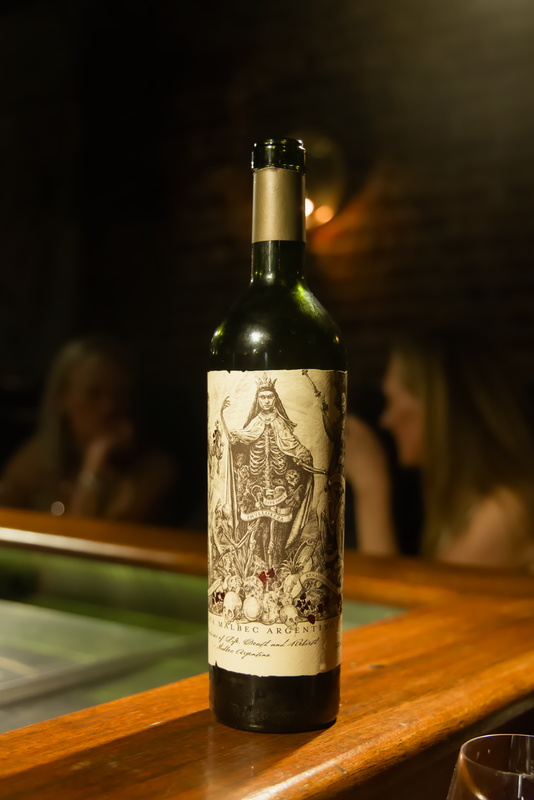
You can't read the scrolls around the skeleton's pelvis at this scale, but they say “Late 1800s” and “Phylloxera”, which is the insect that nearly destroyed the wine industry in the 19th century.
Chile still has vineyards that have never been infected with Phylloxera, but I don't think Argentina has, so I'm not entirely sure what the point being made is, but regardless, it's a fine drop of Malbec.
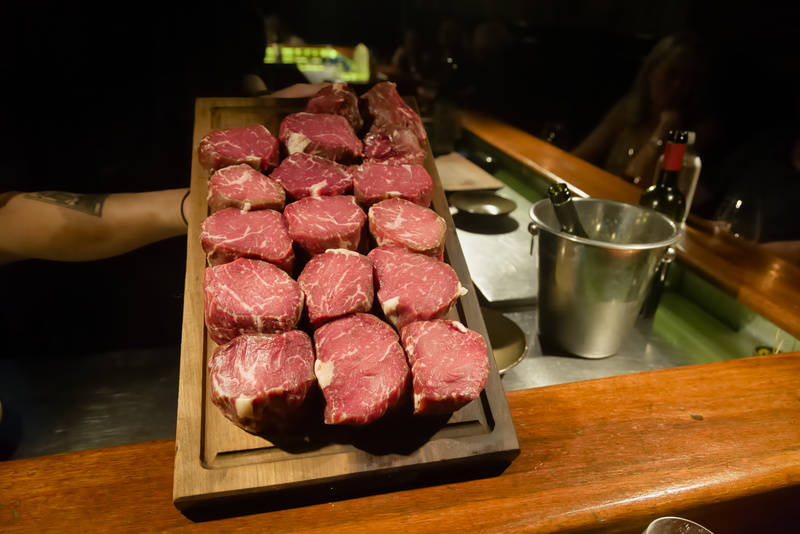
Presenting the meat before it's cooked is all part of the show.
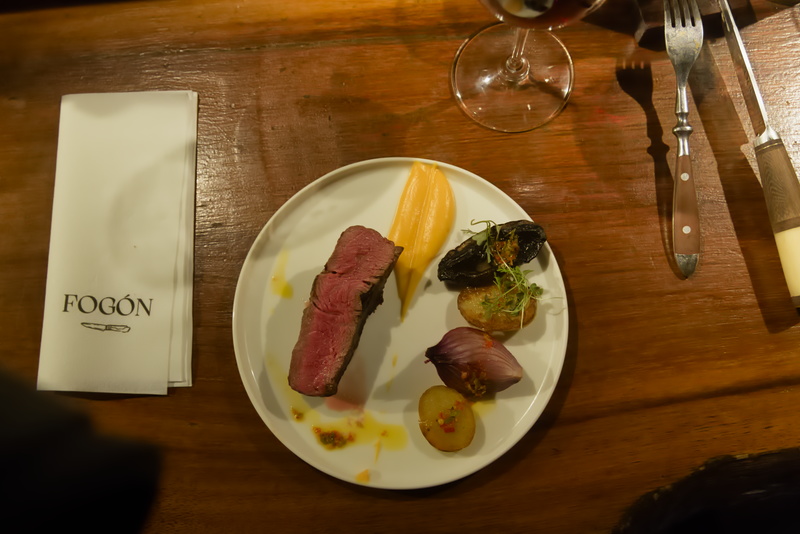
It's seriously good meat, well cooked and well presented, but what about Amanda?
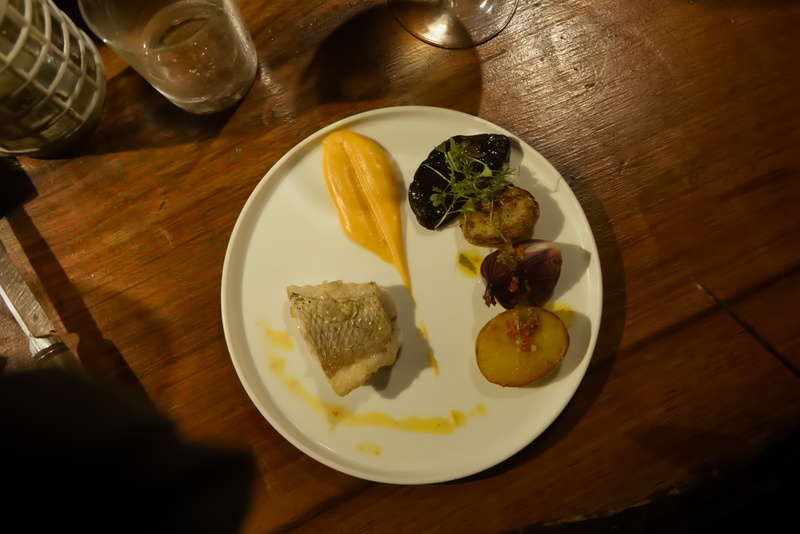
It's absolutely every bit as good!
The guys have said openly that they are a bit nervous because they don't feel the same degree of confidence with fish as with meat, but they have absolutely nothing to fear if tonight's performance is typical.
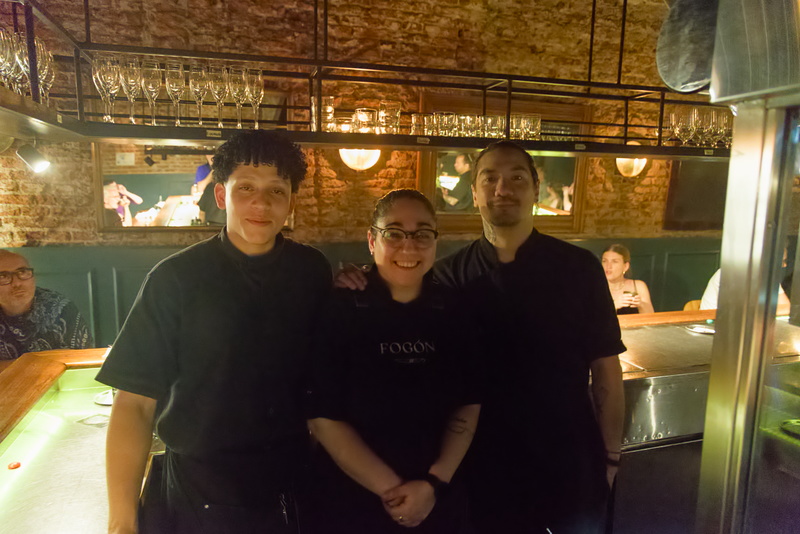
Cheers, guys, you have been absolutely brilliant!
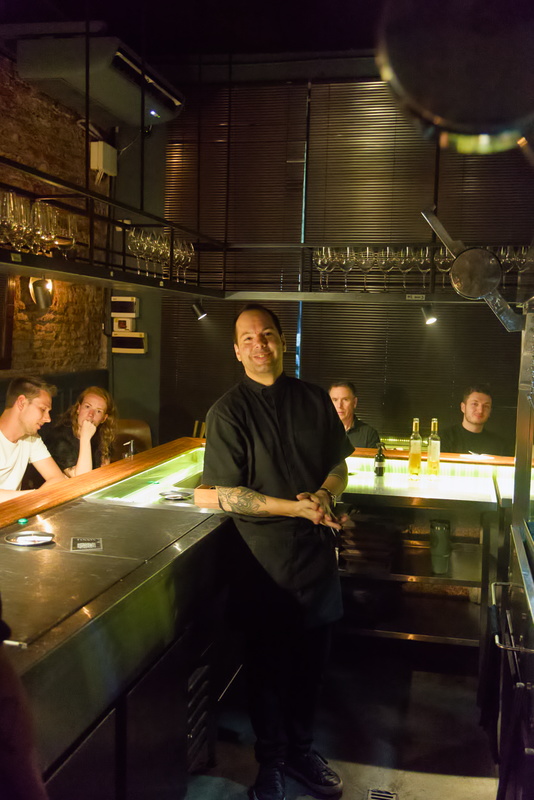
And you too, don't be shy!
So that's an absolute 100% recommendation from both of us, and let's be quite honest, Amanda was not expecting anything a fraction as good from so meat-centric a place. Huge thanks Audley, we'd have been happy if we'd paid our own money for this.
⬅ previous ⬆intro next ➡